
Commission a unified image faster
Reduce time spent moving between projectors and judging seams by eye; the correction runs automatically after the representative regions are selected.
PROJECTION IMAGING | AUTOMATIC COLOR MATCHING
Product goal: use one camera and a short closed-loop calibration to reduce visible color differences between adjacent projection channels, producing a more consistent multi-projector image without lengthy manual adjustment.
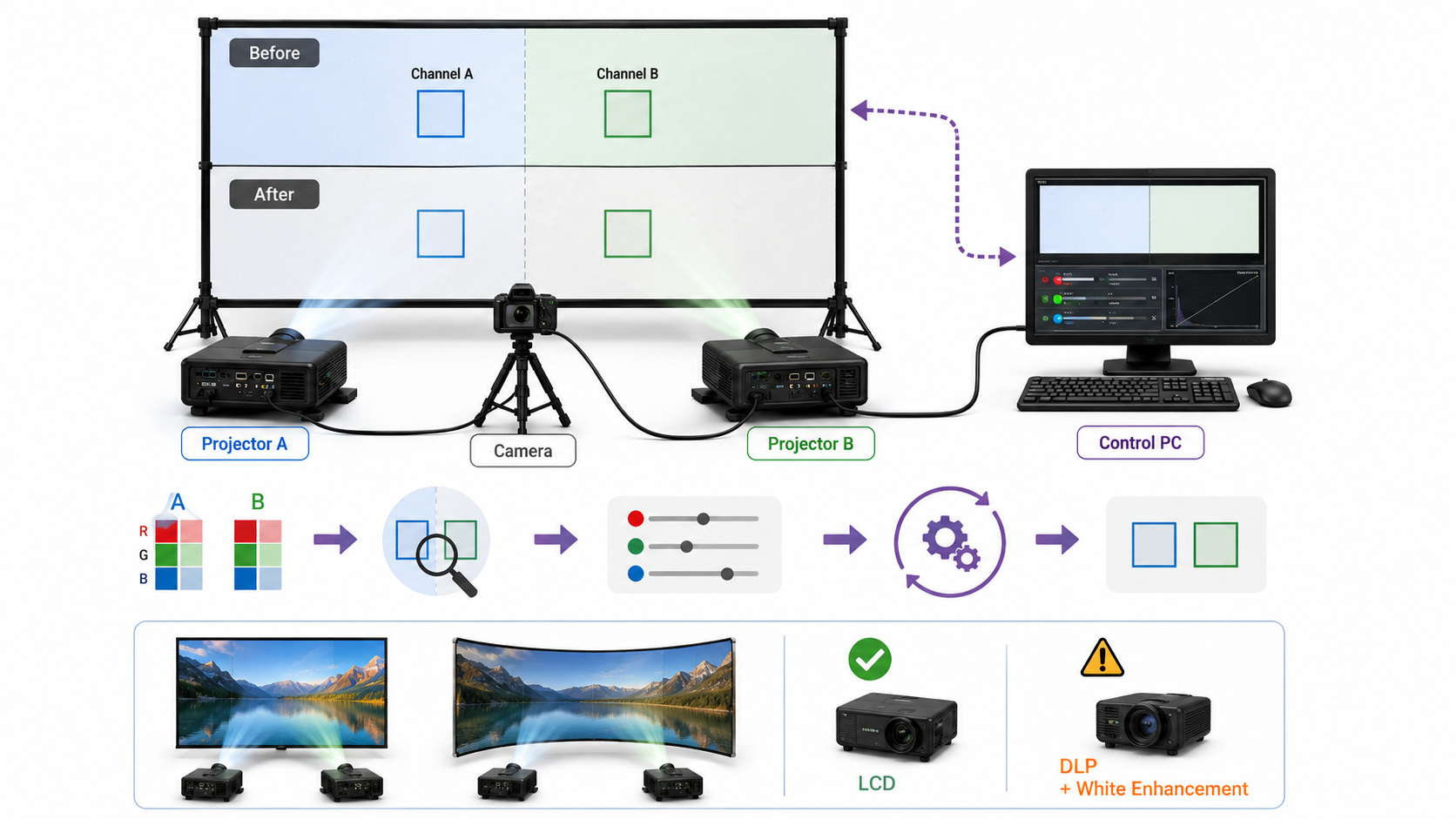
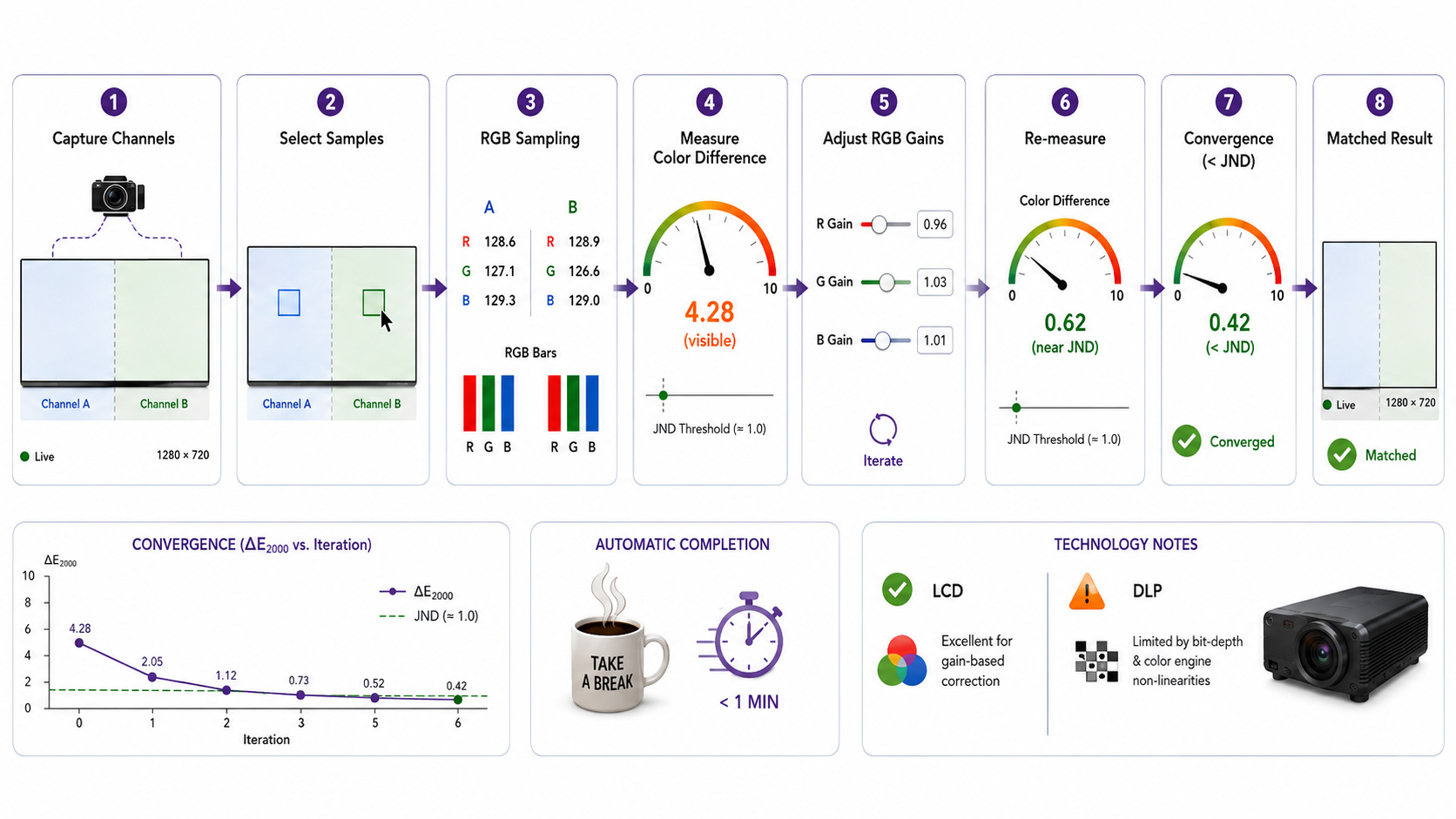
Small color differences become obvious when adjacent images form one large display. The system turns that visual commissioning task into a repeatable process with explicit samples, measured RGB differences, controlled gain updates and a perceptual stopping rule.
Reduce time spent moving between projectors and judging seams by eye; the correction runs automatically after the representative regions are selected.
Convergence below the just-noticeable difference creates a practical user-facing definition of “matched” rather than an arbitrary number of iterations.
Captured regions, RGB components, color difference, gain updates and convergence history provide evidence for tuning and diagnosis.
A still-video camera views the adjacent images simultaneously, reducing temporal and viewpoint differences between measurements.
Interactive rectangles provide compact RGB samples for each channel under the assumption that every projection is spatially uniform within the calibration state.
Measure color difference, update RGB gains, capture again and stop only when the residual falls below the perceptual threshold.
Acceptance should cover camera stability, sample-region uniformity, RGB response, repeatability, convergence time and independent visual confirmation. Projector technologies with additional luminance channels should be detected and routed to an extended calibration model rather than forced through the RGB-only loop.
Next step
Tell us what the process must decide reliably, and we will reply with the measurement we would make first.