
Keep every important source visible
Operators can move and resize feeds directly, recognize a lost source and restore it without rebuilding the entire display layout.
REAL-TIME VIDEO | ACQUISITION AND DISPLAY
Product goal: acquire concurrent video feeds through frame-grabber hardware, render each source in a controllable display window and recover automatically when a signal changes or returns.

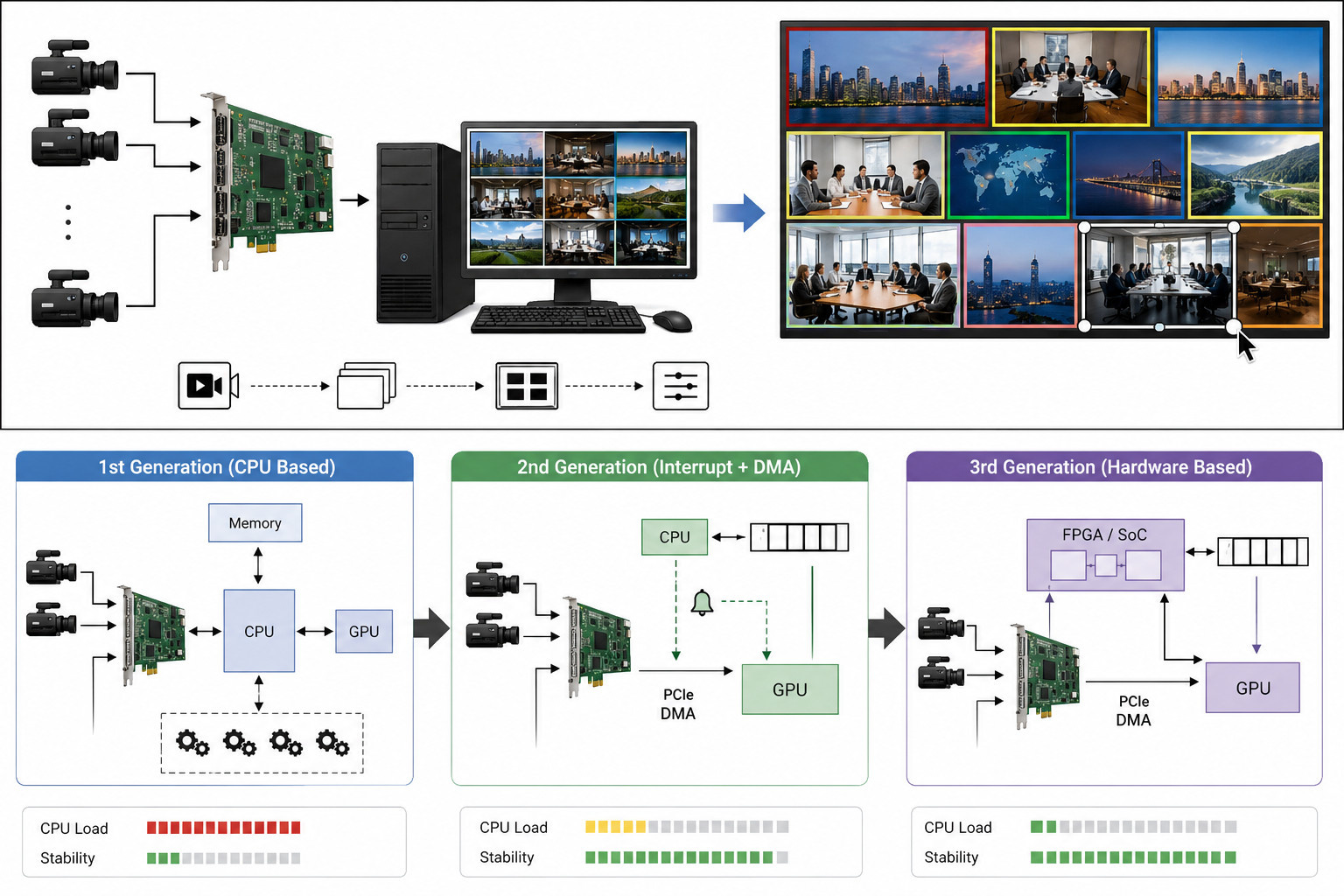
The product joined frame-grabber hardware, real-time rendering, operator-controlled layouts and signal recovery inside an existing multimedia conference platform. Its value was not capture alone, but maintaining a usable wall of live information while sources, layouts and hardware state changed.
Operators can move and resize feeds directly, recognize a lost source and restore it without rebuilding the entire display layout.
Three generations improved the data path and synchronization model while preserving the core product contract: acquire, arrange, render and recover.
Polling and memory copies gave way to interrupts, PCIe DMA, atomic lock-free queues and eventually FPGA/SoC execution.
The first generation polled hardware, copied frame buffers through system memory and synchronized threads with mutexes. It established the product but exposed CPU saturation, frame-drop and resource-contention risks as channel count increased.
Hardware interrupts reported signal changes, PCIe DMA transferred captured frames toward the GPU, and atomic lock-free queues coordinated software without mutex deadlock.
The third generation moved the core processing path into dedicated hardware, with software retained for simulation, control, configuration and system integration.
Production acceptance should cover sustained channel load, frame continuity, end-to-end latency, layout updates, concurrent control actions, signal-loss detection, recovery time and long-duration stability. Hardware and software telemetry should distinguish an absent input from capture, transfer, synchronization or rendering failure.
Next step
Tell us what the process must decide reliably, and we will reply with the measurement we would make first.