
More actionable than detection alone
A 2D box says where a package appears in the image. A 6D pose adds physical location and orientation—the basis for approach direction, grasp planning and placement.
ROBOTIC DEPALLETISING | MONOCULAR 6D POSE
ROBOTIC DEPALLETISING | MONOCULAR 6D POSE
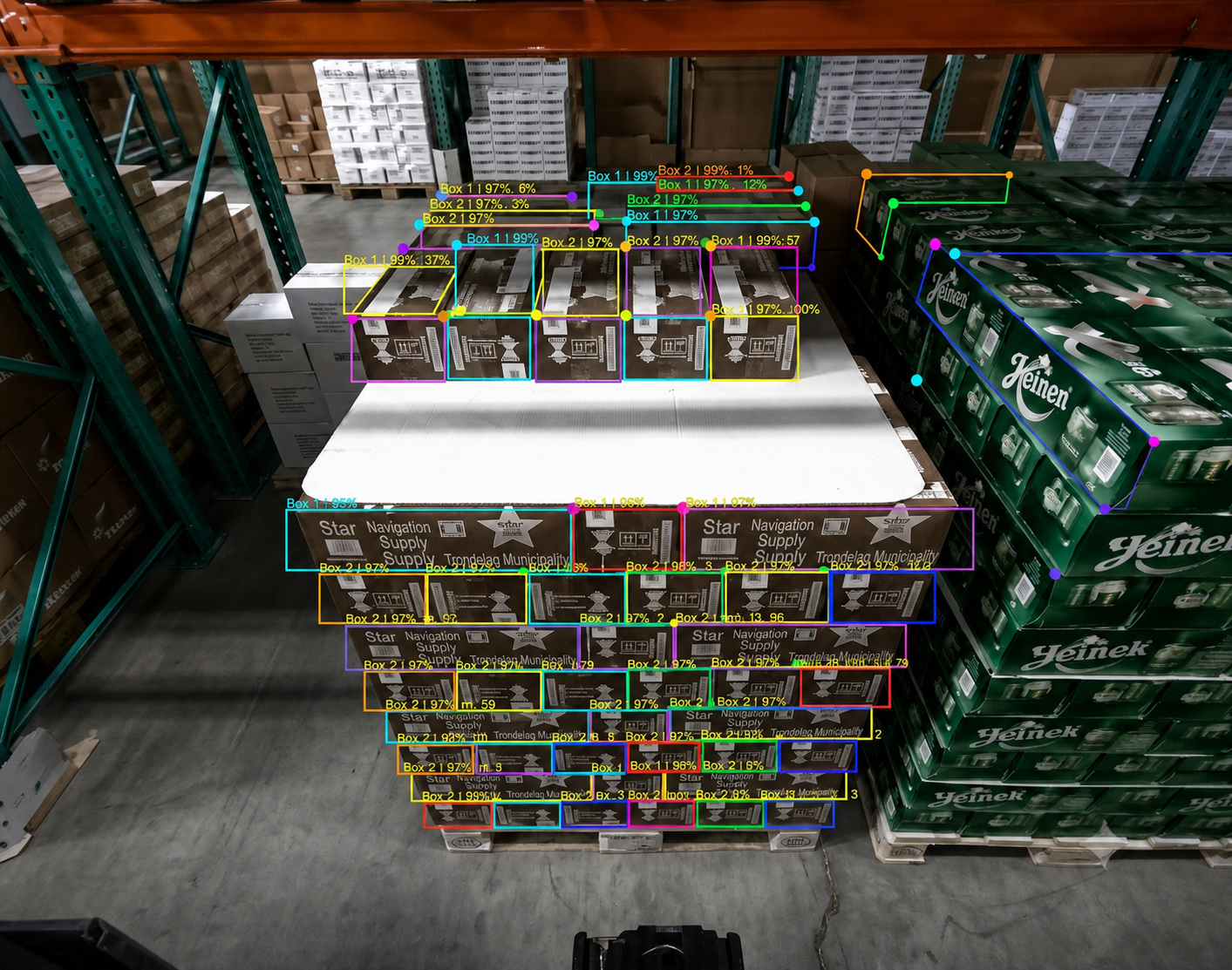
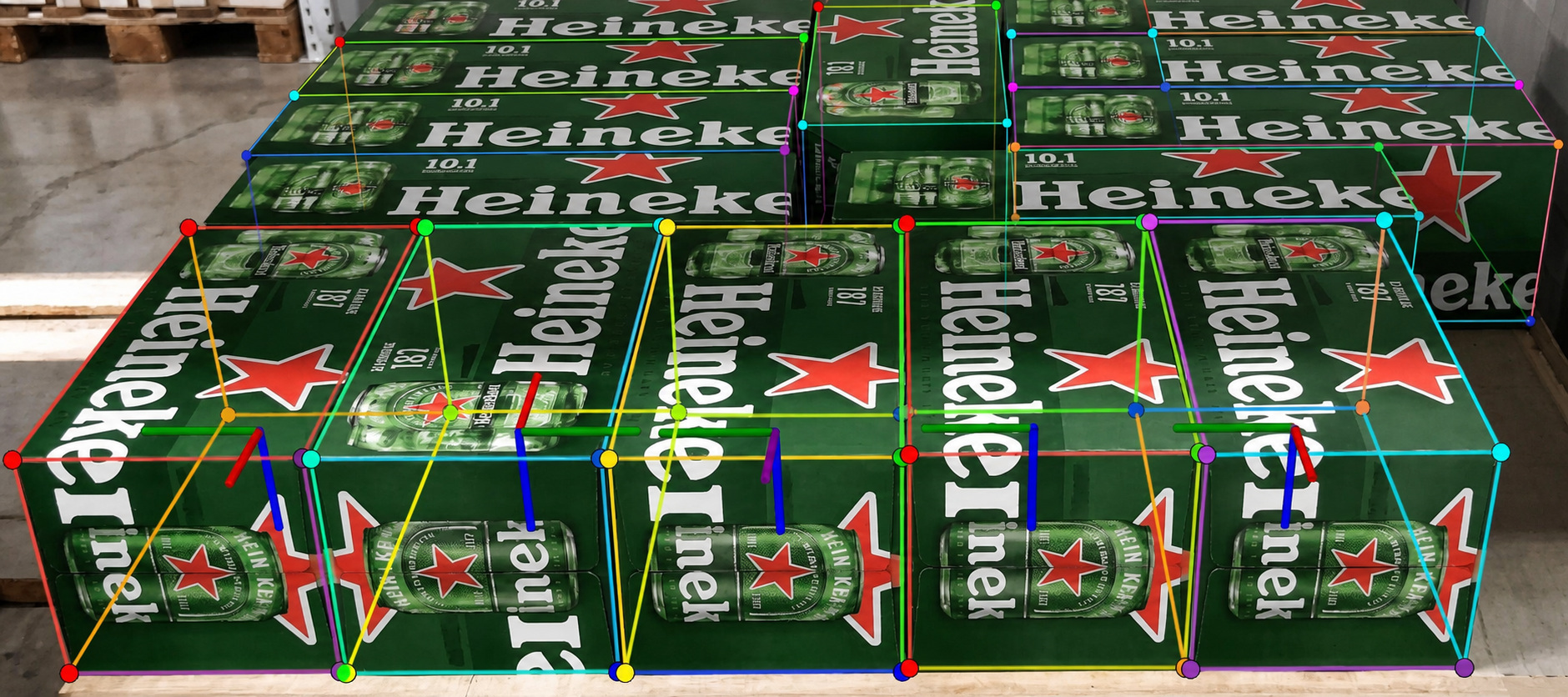
The system connects what the camera sees to the information a depalletising workflow actually needs.
A 2D box says where a package appears in the image. A 6D pose adds physical location and orientation—the basis for approach direction, grasp planning and placement.
Each supported package links appearance to known dimensions. New products can enter through a controlled registration and validation workflow instead of changing the whole perception stack.
Detected surfaces, matched corners and projected 3D edges create intermediate evidence. Teams can see where a pose came from and where a failure should be investigated.
The code combines image learning with product knowledge and calibrated camera geometry. Each stage has one clear responsibility.
Local contrast and tone correction reveal printed packaging detail across shadows, bright areas and reflective wrapping.
A trained detector proposes package regions so precise matching can focus on useful parts of a busy warehouse scene.
Local visual features match the observed face to a registered template. Robust estimation discards correspondences that disagree.
Known dimensions and camera calibration recover the metric box pose. Reprojected edges provide an immediate geometric check.
The project targets a practical gap between seeing a package and being able to handle it. Its output can support:
The repository separates data preparation, learned detection, template matching and pose solving. That modularity gives architects and developers practical control:
The repository proves the architecture and data workflow, but it does not contain an independent production acceptance study. A credible deployment claim must therefore be measured in the target cell, using the customer's products, cameras, lighting, stack patterns and grasp tolerances.
A focused assessment can define catalogue scope, representative scenes, acceptance thresholds and the integration boundary with robot planning.